The Engagement Cortex: a fundamental tool for an evolving practice
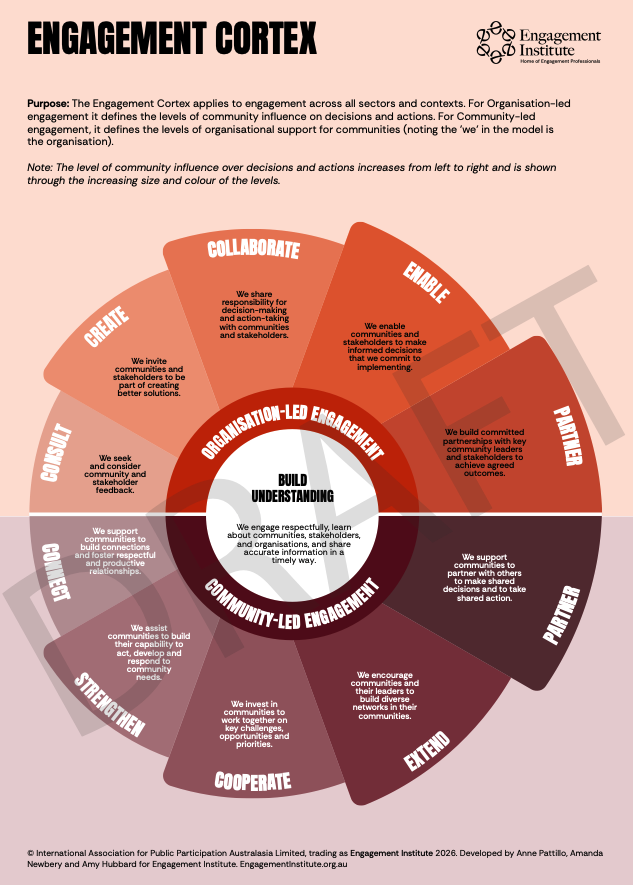
Photo: The Engagement Cortex, Engagement Institute
If you regularly read my blog, this time I've gotten granular and detailed about one specific aspect of the engagement practice.
I got an email from the Engagement Institute (formerly IAP2 Australasia) today with a link to a new model for the practice. You can review the model and all the info about it here.
I'm sometimes cynical of these announcements about advances in the practice. They can fall short of what they promise, so I got a cup of tea and a commitment to an open mind and dug in to learn more.
IAP2 and all its regional organizations have been the gold standard for training in the engagement practice for 25+ years, but in recent years the organization has gotten lost in polarizing conversations on a pendulum of "don't change it, it's perfect" all the way to "throw it out and begin again" about the core models of the practice. That has meant very little movement, enormous time, energy and effort and little change to the supporting tools of the practice, in a time of intense volatility, change and uncertainty. More than ever, people doing the leadership work of bringing others together to talk about hard things need tools that meet the moment - and IAP2 has been mired in talking to itself, often behind closed doors, instead of building capacity to meet this moment of declining democracy, intense polarization and reactivity.
Until now.
Now the Engagement Institute (formerly IAP2 Australasia) has stepped up and produced a tool that reflects contemporary practice, is flexible and inclusive of what is really happening in the field.
It is part IAP2 Spectrum, part Community Engagement Model (or Profiles of engagement depending on where you are located in the world), part guiding principles and foundations of engagement. It brings these 3 core elements together into one model that is simple, clear and easy to understand.
The cortex will undergo testing, engagement and input to see how it is received and how it will work. That in itself is good practice, and all the models of this work, and the associated training, should undergo regular review to see how they meet the moment.
Here is what I see:
- It reinforces sharing information to build reciprocal understanding as a core of the practice, and requires relationship building to understand the communities and groups in the conversation. These are guiding principles for meaningful engagement and it places them at the centre - a people centred model since this work is entirely about people.
- In the guidance note it reminds us that engagement is a process, rather than an event or activity and we need to be clear about context, scope and purpose and understand who is leading the engagement before we use the tool.
- The tool provides a powerful reminder that in today's environment, the organization may not be leading the engagement, and supports growth and learning about this reality. This can be especially helpful in organizations where engagement has been traditionally led by them, with all the power, influence and choice-making in their hands. This opens up a different way of recognizing how engagement can be practiced, and what role the organization can play.
- It combines core tools of the practice and makes them directly applicable - the spectrum and the profiles / engagement model in one place which reinforces an understanding of who is leading and who is acting in the practice and how much influence they have in one simple to understand tool.
- In the practice framework it is suggested we use both the model and the cortex - and I assume this is because the cortex applies only to one perspective of the profiles? So if the organization wants to know what role it plays and how much influence it and others have in a situation, then the organization should use the cortex to understand that. But I don't think it works from other perspectives?
Here is what I wonder about:
- This model is great if you are a traditional organization leading engagement. While it acknowledges and recognizes that community can lead the engagement, the perspective remains that of the organization. Can the cortex be turned on its head and the other side of it be presented from the perspective of community - when they lead, and when their leadership becomes a de-centralized movement? Could it be adapted to support the grassroots work of social change, community development, pro-democracy movements? As a tool of democracy it would be great to see the model get beyond the organization-centric perspective.
- How well does the model cross cultures and world views? Does it work in the context of Indigenous governance or engagement? With diverse and divergent communities?
- Will the spectrum become obsolete as the cortex is applied?
- The emphasis on relationships is there but not explicit. I wonder if it should be enhanced to reflect engagement that is not project specific and instead is ongoing and long-term? That said, does this tool work outside of project specific engagement?
- I'm wondering if there are deep questions that guide the choice making about influence and that reinforce context, purpose and commitment? How do leaders choose the level of influence?
- Why the name? It immediately brought to mind spiny, crawly sea creatures and possibly aliens. When I looked up the definition I read "the outermost or superficial layer of an organ or structure in animals and plants." I'd love to hear the origin story of the choice of name.
There is reference to three years of engagement leading to this new tool and model of the practice. I find that interesting, as the engagement was mostly about the IAP2 spectrum, and many of the things I see reflected in the cortex were raised in those conversations.
Yet, the Engagement Institute Board said there should be only minor changes to the spectrum, and then this new tool is produced. I find that curious. As noted above, I think this new tool is fabulous, and long overdue that IAP2 and/or one of its regional groups produced a new tool for the reality of today's practice. Will this tool be available to all the regional bodies of IAP2? Will it be incorporated into the global learning pathway? Perhaps this new tool also shines a light on the convoluted, conflict-ridden world of IAP2 itself as a governing body of the practice?
Now that the Engagement Institute has taken on the spectrum / engagement model evolution, will they (or IAP2 International) have the courage to update the badly out of date Core Values and Code of Ethics? Core tools of our practice, they haven't been updated in decades, and countless organizations have enhanced, improved and stepped far beyond these foundations of the practice to create contemporary guiding documents for the work and the leaders in the field.
Is that next? I'd love to see that happen. I'd even put up my hand to participate. As long as it doesn't take years and contribute to the "don't change it, it's perfect" all the way to "throw it out and begin again" pendulum.
Good work Engagement Institute. It isn't perfect, but it is a significant contribution to advancing the practice.